Forge-backed review
Open an osr-forge workdir — a directory with run.json — and the editor becomes the graphical correction loop the forge spec anticipated: the draft on the map, the report beside it, the source pages behind it.
The contract
In a forge-backed project the editor writes exactly one artifact of its own, the editor.json sidecar. Everything else honors forge's assembly purity: your edits become merged, reasoned overrides.yaml entries, and the draft re-assembles through forge's own pure assemble() — never a hand-patched adventure.json, report.json, or preview. Re-running forge yourself reproduces the session's artifacts byte for byte, and a symlink publish republishes live on every correction.
Undo and redo work on the same terms: each step is a snapshot pair of the overrides file and the reason ledger, so history is honest about what the correction record looked like at every point.
Review
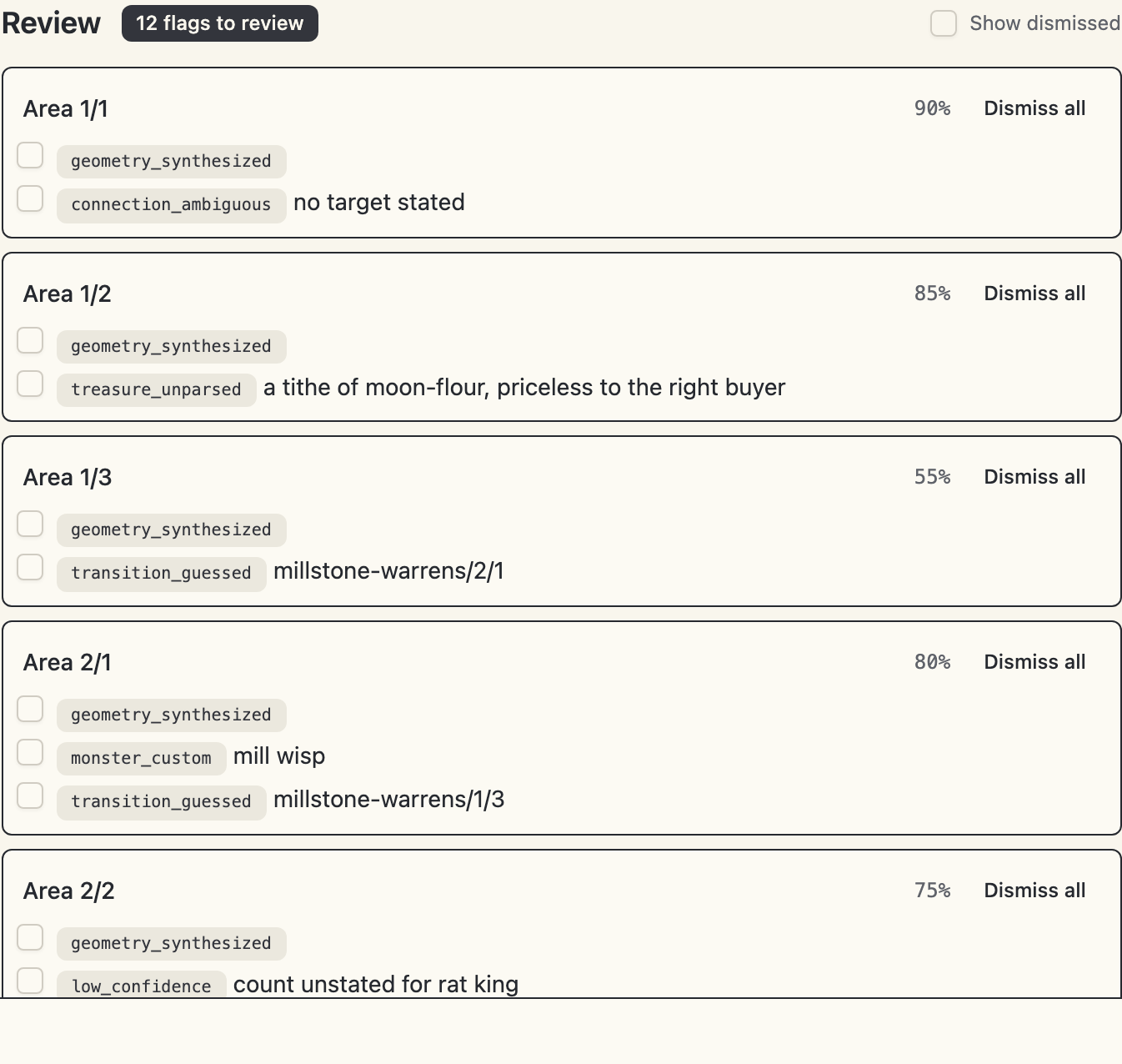
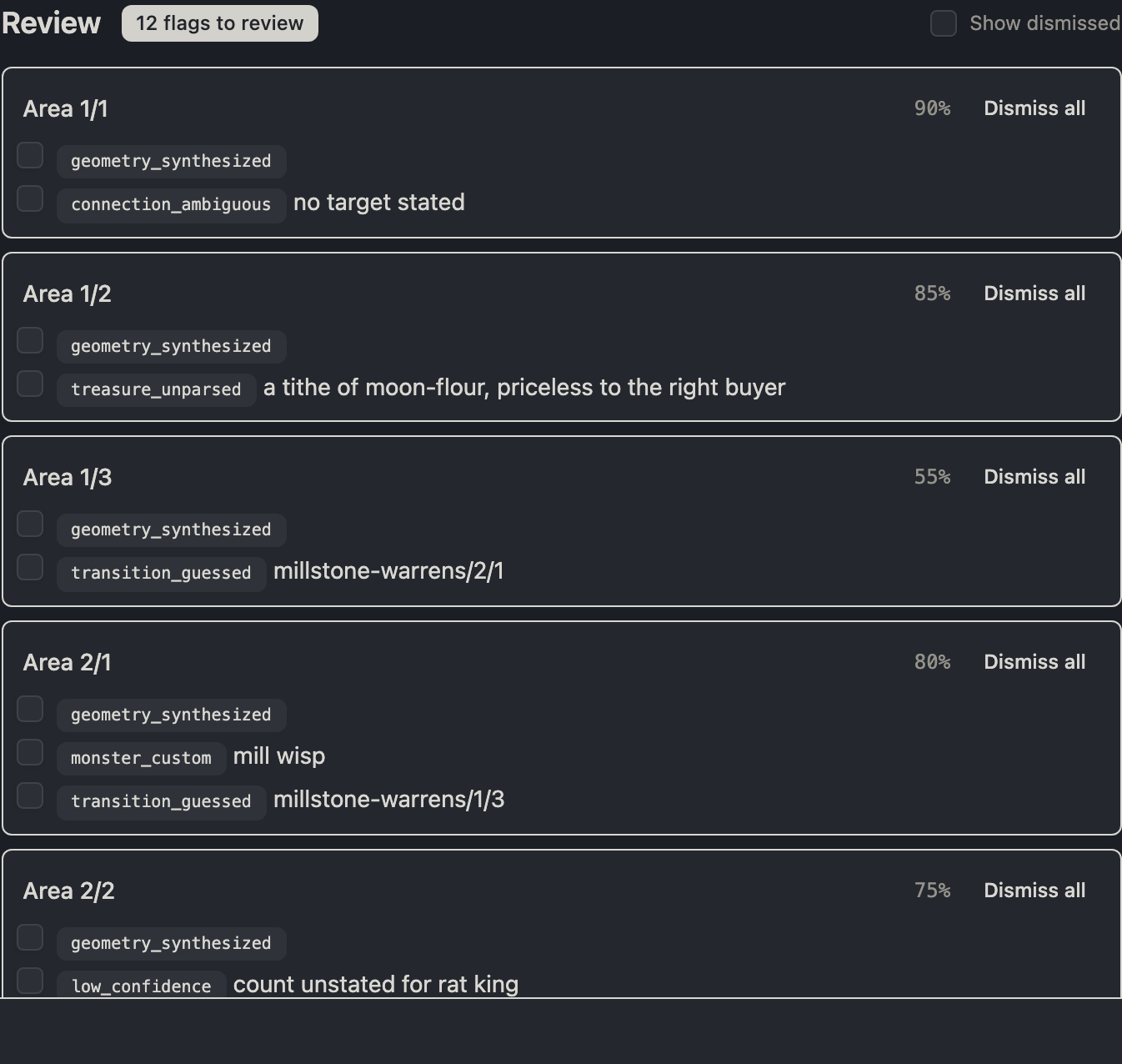
Review lists report.json's flags as a work list. Selecting a row jumps to the flagged area with its printed pages rendered alongside, and each flag has its own dismissal mark — reviewed-and-fine is recorded, not remembered.
Correction happens against the page. Here a different conversion — The Root Cellar of Old Wenna — has a flagged area open with the printed page it came from rendered beside it:
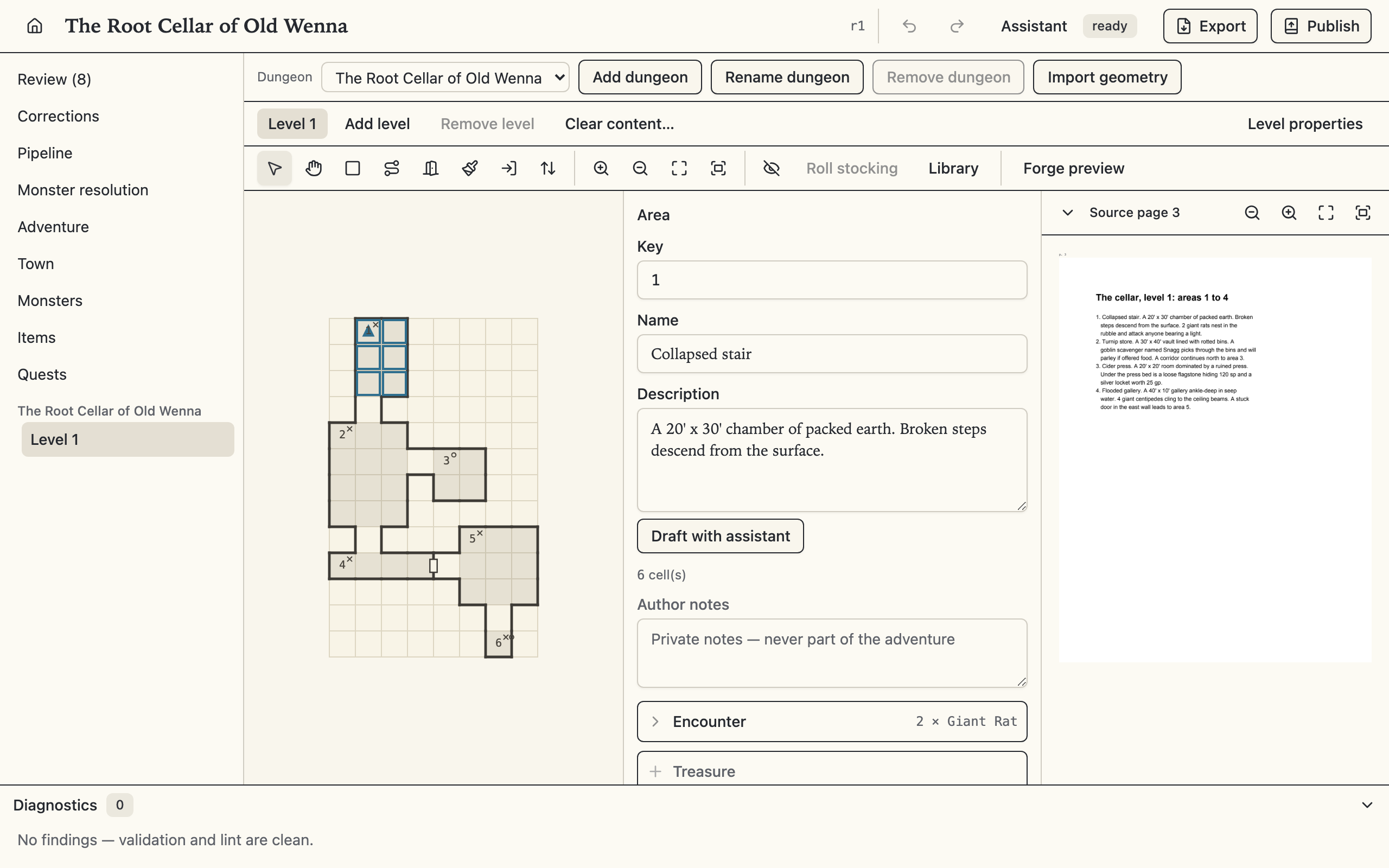
The page is a viewer, not a thumbnail. It opens fitted to the pane, and from there it moves like the map: drag the page to pan it, wheel or pinch to zoom about the pointer, Fit page to frame the whole page again, Reset page zoom for full size. When the printed block is what you are reading, drag the pane wider — the width is remembered with the rest of the project's layout.
Every edit you commit gets an auto-drafted, page-anchored reason: redrawing geometry writes explicit wall seals over stale synthesized openings, importing a level lands as geometry: overrides, drawing past the derived extent grows it by rule. Machine drafts are badged until a human composes the reason — the record stays reviewable either way.
Corrections
Corrections is that reviewable record: every overrides.yaml entry with its reason inline-editable and per-entry removal. It is the answer to "what did we change about this conversion, and why" — the same answer a colleague re-running forge from the workdir would reconstruct.


Monster resolution
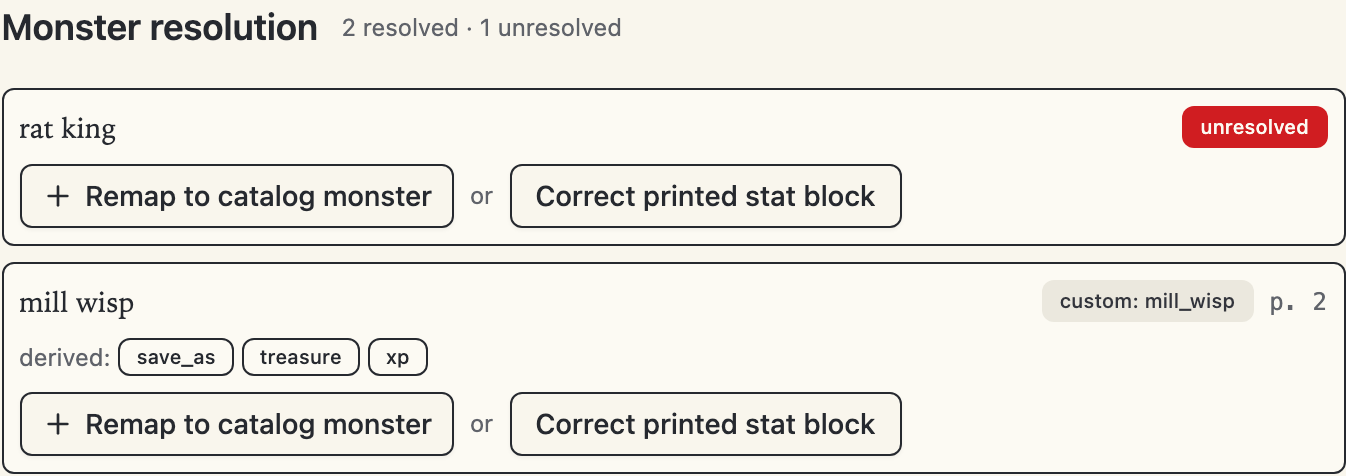
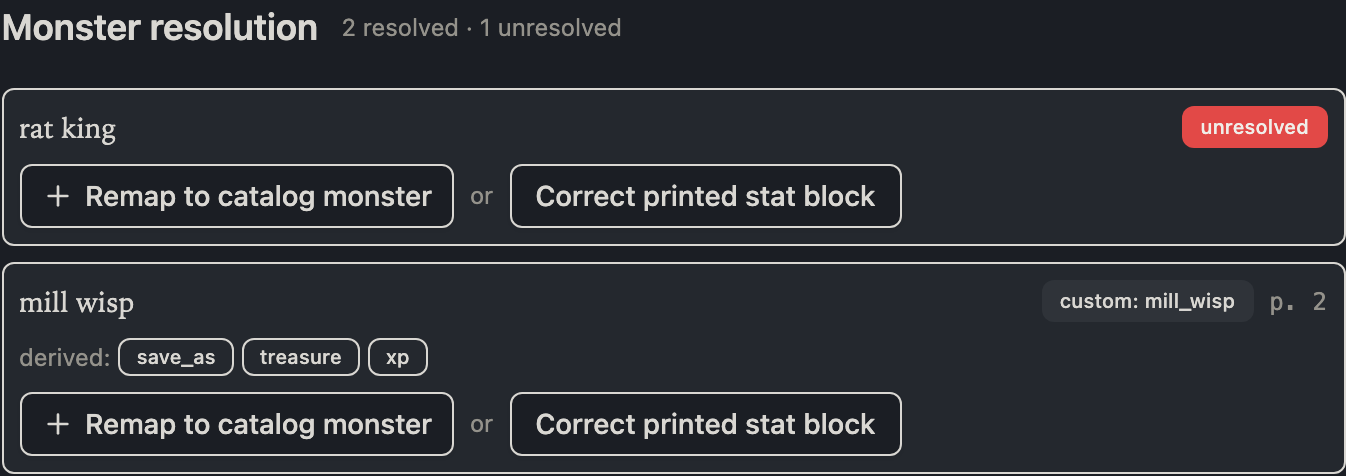
Monster resolution offers each unresolved or custom monster name the two corrections forge defines, as an either/or per name: remap to a catalog monster, or correct the printed stat block in the page's own notation (pre-mapping, per forge's contract). When osr-forge's stat-block veto discarded the catalog monster it picked for a name, because the printed stat block contradicts it, that name's row also shows the discarded pick and the veto's detail. The Monsters section stays present as a review view of the derived bundle.
Pipeline
Pipeline renders run.json's per-stage status and token usage, runs the on-demand playability check (findings clear on the next change — stale lint about a changed draft is worse than none), re-runs assembly with its knob, and reaches every other stage with progress and cancellation — see converting a PDF for stage reruns.
Detach
Some edits have no override vocabulary: new dungeons or levels, wandering tables, resizing. The editor blocks these in place and offers detach — the recorded, one-way crossing to a native project, with provenance written down and author notes moved across. After detach the project is yours entirely; the workdir stays behind, unchanged, still reproducible.