Quests
A quest is the goal the engine tracks for your module: recover the idol, and the adventure is won. The quest list lives in the Quests section below the triggers, and the two share a vocabulary on purpose — every clause in a quest is built from the same patterns and conditions a trigger uses, and every reward is one of the same nine referee commands.
A quest has a required name (the words the player's quest log shows), an optional activation clause, one or more objectives, optional rewards, a completion rule of all or any, and the one field behind victory: concludes the adventure.
Creating a quest
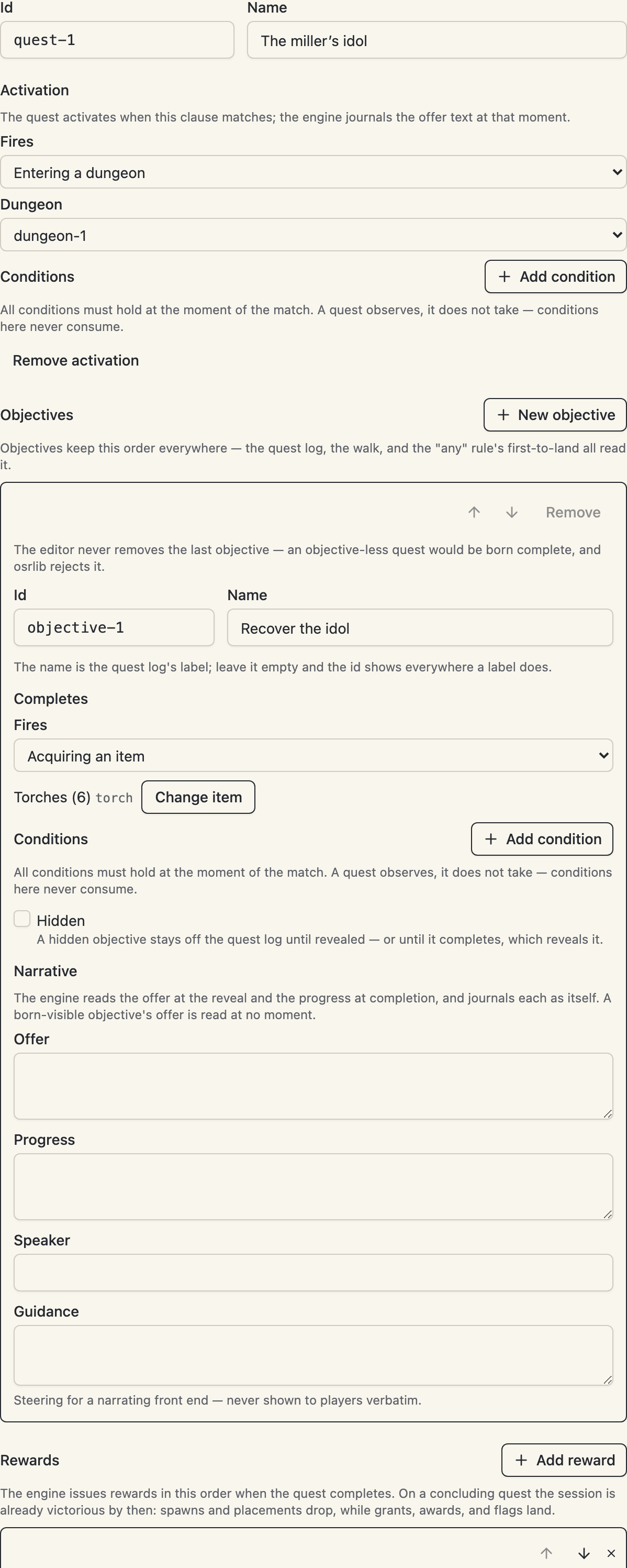
New quest collects exactly what a quest must have to exist: an id, the name, and the first objective's completion pattern. A quest without a name or without an objective is not a valid document shape — under the all rule an objective-less quest would be born complete — so the dialog won't create one. Everything else is detail-editor work; the first objective is minted objective-1, and you rename it there.
Activation, or the standing charge
A quest with no activation clause is a standing charge: active from the session's first moment, on the party's list before they take a step. Two honest consequences follow from there being no activation moment: the engine never journals the quest's offer text (there is no moment to journal it at), though the quest still shows in the player's quest log from the start.
Add activation turns activation into an event the party crosses — entering the dungeon, taking a specific item, any of the seven patterns — optionally narrowed by conditions. When an activation clause matches, the quest activates and the engine journals its offer text at that moment. Removing the clause returns the quest to a standing charge.
Objectives
Each objective is a thing the party can accomplish, with a completion clause built from the same pattern-plus-conditions shape. Order matters everywhere it shows: objectives keep their authored order in the quest log, in the engine's walk, and — under the any rule — in which objective's landing completes the quest.
- The name is the quest log's label. It is optional; an unnamed objective shows as its id everywhere a label shows.
- Objective ids are unique within their quest (two different quests may reuse an id), and the editor refuses a duplicate as you type it.
- A quest keeps at least one objective — the editor never removes the last one.
Hidden objectives and reveals
A hidden objective stays off the player's list until it is revealed. There are two ways out of hiding:
- When a reveal clause — the same clause shape again — matches, the engine surfaces the objective and journals its offer text at that moment.
- Completing a hidden objective reveals it. A hidden objective with no reveal clause is a perfectly normal shape: it surfaces by being done.
A reveal clause only makes sense on a hidden objective, so unticking Hidden clears the reveal clause in the same gesture.
Because the engine reads an objective's offer text only at its reveal, a born-visible objective's offer is read at no moment — author the progress beat for objectives that start on the list.
Rewards
Rewards are the same nine commands a trigger's consequences use, under the same rules: recipients are the whole party or the first living character (never a typed character id), and the engine issues them in authored order when the quest completes.
One ordering fact is worth knowing for a concluding quest: the victory transition happens before the engine issues the rewards. Grants, awards, and flag writes still land — the epilogue paying out — but spawns and placements are dropped, because the session is already over and there is nothing left to fight or walk.
All, any, and concluding the adventure
Completion is all (every objective) or any (the first to land — when one moment would complete several, the first in authored order counts).
Concludes the adventure marks the quest whose completion ends the adventure in victory: the engine switches to the victory state and journals the quest's completion text with it. Author one concluding quest per module — the engine caps nothing, but once the first one completes the session is over, and a second concluding quest can only ever add a journal line.
The two beats, journaled as themselves
A quest's narrative block holds offer (shown and journaled at activation) and completion (shown and journaled at quest completion). An objective's block holds offer (at reveal) and progress (at its completion). The engine shows and journals each beat on its own lifecycle event, as itself — there is no separate journal voice to author, which is why the editor offers none. When a foreign document's block holds text in a beat the engine never reads for a quest (a journal or fired line), the editor flags it by name with a one-click clear.
Speaker and guidance are on every narrative block, as always.
The advisory lints
Two advisory checks watch the quest layer, joining the three on the trigger layer. Warnings by construction — they never block publishing:
- Unpriced treasure rewards (
quest_reward_unpriced) — the quest's rewards grant treasure the XP machinery will never price, with no XP award beside them. Granted items always count zero toward XP under the engine's valuation rule; granted coins on a concluding quest land after victory, where the return-to-town award never runs. Either way the players get the loot but never the experience — add an Award XP reward if the payment is meant to count. (The game prices granted coins on a non-concluding quest at the next return to town, so those are not flagged.) - A key nothing places (
key_not_placed) — a door or stair gate names a bundled item that no treasure cache holds and no trigger or non-concluding quest reward grants. The party can buy shipped items in town, but a bundled item exists only where you put it — and a concluding quest's grant doesn't count, because it lands after the adventure is already over. The finding sits on the gate that can't be satisfied.
What lives in saves
A quest's lifecycle state — activated, revealed, completed — lives in the play session's save, keyed by quest and objective ids, not in your document. Renaming a quest orphans it in existing saves: loading a save replaces the session's quest state wholesale, so the renamed quest has no entry at all — the engine skips it silently, and it never activates, never appears in the quest log, and never advances in that save. Renaming an objective orphans one level down — under the all rule, a quest with a renamed objective can never complete from an old save. Fresh sessions are unaffected. This is the game engine's own posture, and the editor does not attempt to repair old saves.
In converted projects
The forge-backed posture is the same as for triggers: no forge-assembled document can hold quests, the gap is osr-forge#39, and the Quests section offers Detach to a native project in place.