Treasure
The treasure card declares what a room holds on its own — loot that isn't already coming with the monsters. Its card is one of the four in the area panel, reached the way stocking reaches all of them.
A declaration, not a hoard
Nothing is rolled when you key the room. The card records what to generate; the coins, gems, and magic fall when the game generates them, on the party's first entry into the area. Two rooms declaring type C are two different hoards at the table, and re-opening the project doesn't reroll anything, because there is nothing rolled to store.
The magic in a hoard is rolled at the tier the party is playing at — basic while the highest living character is level 1–3, expert from level 4 — so the declaration is the same whichever tier the game eventually rolls it at.
That's also why an encounter's monsters need no treasure card. Their lair hoard is generated from their own stat blocks — see where a monster's treasure comes from. Declaring their letters here would generate the hoard twice.
Treasure types or the unguarded band?
The card's two modes name two different tables, and they're mutually exclusive — the model enforces that, so a card is one or the other and never both. Switching to the band roll replaces whatever letters you had; switching back clears the card to its empty state, where the next letter you pick starts a fresh declaration.
Treasure types are the lettered hoards a monster's entry names. The picker groups all 22 letters the way the SRD does: hoard (A–O) is the lair treasure something sits on, individual (P–T) is what a single monster carries, and group (U–V) is what a band carries between them. The game generates whatever letter you name. Hoard letters are the usual choice for a room; declare P and you get one monster's pocket money lying on the floor. This is the mode for a hoard something is sitting on, or for following a printed module's key.
Unguarded band roll is the other table: loot lying about with nothing guarding it, which the SRD rolls by dungeon level rather than by letter. Levels are grouped into bands — level 1, levels 2–3, 4–5, 6–7, and 8–9 — and the deeper the band, the larger the amounts and the better the odds on gems, jewellery, and magic. A band roll is a roll on the band your room's level falls in.
You don't pick the band. It comes from the level the area sits on, so move a room to a deeper level and the game rolls richer without the card changing. Level 10 and deeper use the 8–9 band, the last one the table prints.
SRD stocking uses this mode too: an empty or trapped room whose treasure die comes up gets an unguarded declaration rather than a letter.
Seeing what a declaration produces
Preview sample hoards rolls the declaration three times and lists what each roll produced, so you can judge a letter and change it before you build the room around it. The card commits as soon as you pick, so previewing always follows the pick — and changing your mind is one more undoable batch. Nothing about the preview is written down and no seed advances.
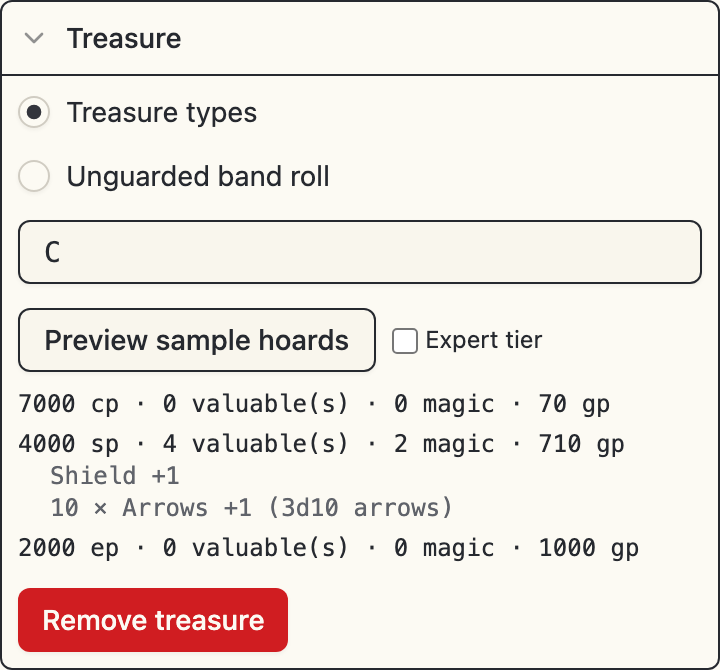
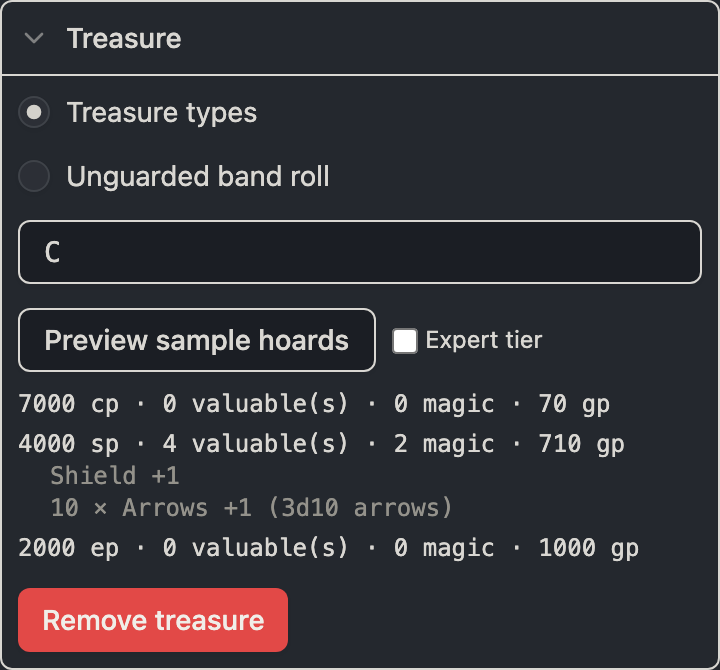
Reading a treasure preview covers how to read the lines — in particular that the trailing figure is the hoard's total worth in gold, not a count of gold coins. The first sample above is the clearest case of it: 7000 copper pieces and no gold at all, worth 70 gp.
Treasure that isn't a table roll
A specific item, a named valuable, or a counted pile of coins is a feature, not a treasure declaration — features hold item ids from the equipment catalog, explicit coins, and named valuables, and a treasure cache feature can have its own trap. Use the treasure card when you want the tables to decide, and a feature when you already know what's in the room.