Traps
A trap is built from composable parts rather than picked from a list, because B/X traps are one-off contraptions. Set the parts that apply and leave the rest alone; an unset part isn't part of the trap. Its card is one of the four in the area panel, reached the way stocking reaches all of them.
Where a trap lives decides its kind
There are two kinds and the builder never asks which one you want:
- A room trap is the area's own trap — the pit in the floor, the scything blade across the doorway. It's the trap card in the area panel.
- A treasure trap guards a cache. It's the Trap this cache action inside a treasure cache feature, and it protects that cache specifically.
The kind follows from where you added it, and the models enforce the split, so a trap can never end up filed as the wrong sort. What differs between them is not the effect you build — both offer the same effect fields — but which engine path springs the trap.
The trap's shape
Trigger names the springing action, and a room trap offers the choice: enter springs when the party steps onto a cell of the area — the pit-in-the-floor construction — and open springs when a door of the area is opened, from either side, the blade that drops when the door swings. The help under the field states the chosen value's springing action. A cache's trap springs when the cache is opened and the engine reads no trigger at all, so the builder shows no trigger field for a treasure trap.
A room trap also isn't certain to go off. Entering the cell springs it 2-in-6, the way B/X handles a party walking over a pit, and a trap the party has already found, removed, or sprung never fires again.
Affects is the triggerer alone or the whole party — the difference between the character who stepped on the plate and everyone standing in the room when it goes off.
The effect
Every field below is optional, and a trap is the sum of the ones you set. Nothing stops you combining them: a dart volley that also poisons is a damage roll, a volley count, a save, and a condition on one trap.
- Damage — the dice rolled on a hit.
- Volley — how many of it, for the trap that fires a spray of darts rather than one. Available only once damage is set, since a volley of nothing is nothing; clearing the damage clears the volley with it.
- Save — the category the victim saves against (
death,wands,paralysis,breath, orspells), with a Modifier for the trap that's easier or harder to dodge and On save choosing whether a successnegatesthe effect outright or takeshalf. - Save or die — the classic lethal trap. It takes precedence over everything else that would happen to the victim: the damage, the fall, and the condition never apply. Pair it with a save set to
negates. Ahalfsave does not stop a kill, so Save or die with On save: half is lethal to everyone the trap catches, saved or not. - Condition — what the victim is left with:
poisoned,paralysed,asleep,blind,petrified, and the rest of osrlib's condition vocabulary. Duration and Unit say for how long — a fixed number or a dice expression, inround,turn, orday. Both are available only once a condition is set, and clearing the condition clears them. - Fall (feet) — the drop, for the pit.
- Slide — where the chute dumps the party: pick the destination dungeon, level, cell, and facing, the same target gesture the map's transition tool uses. It relocates them outright rather than adding a transition to the map, so nothing leads back up. It also applies to the whole party whatever the rest of the trap says — the party has one location — so a slide fires on a triggerer-only trap, and fires even when every character saves.
- Manual effect — prose, for what the rules leave to the referee. Everything B/X describes and no field above can express goes here. The engine holds it and never automates it, so it is a note to the human running the game rather than a mechanic.
The builder holds those dependencies by construction rather than validating after the fact, so the trap you're editing is a legal trap at every keystroke — which is why the dependent fields disable instead of complaining.
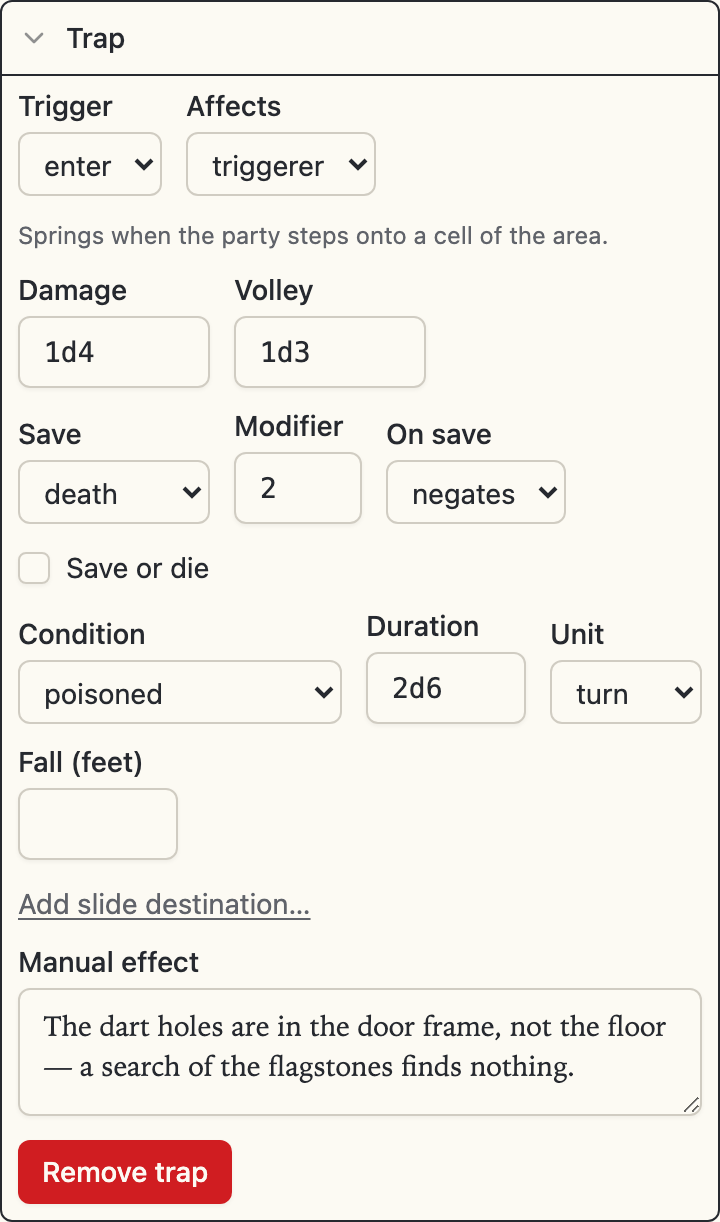
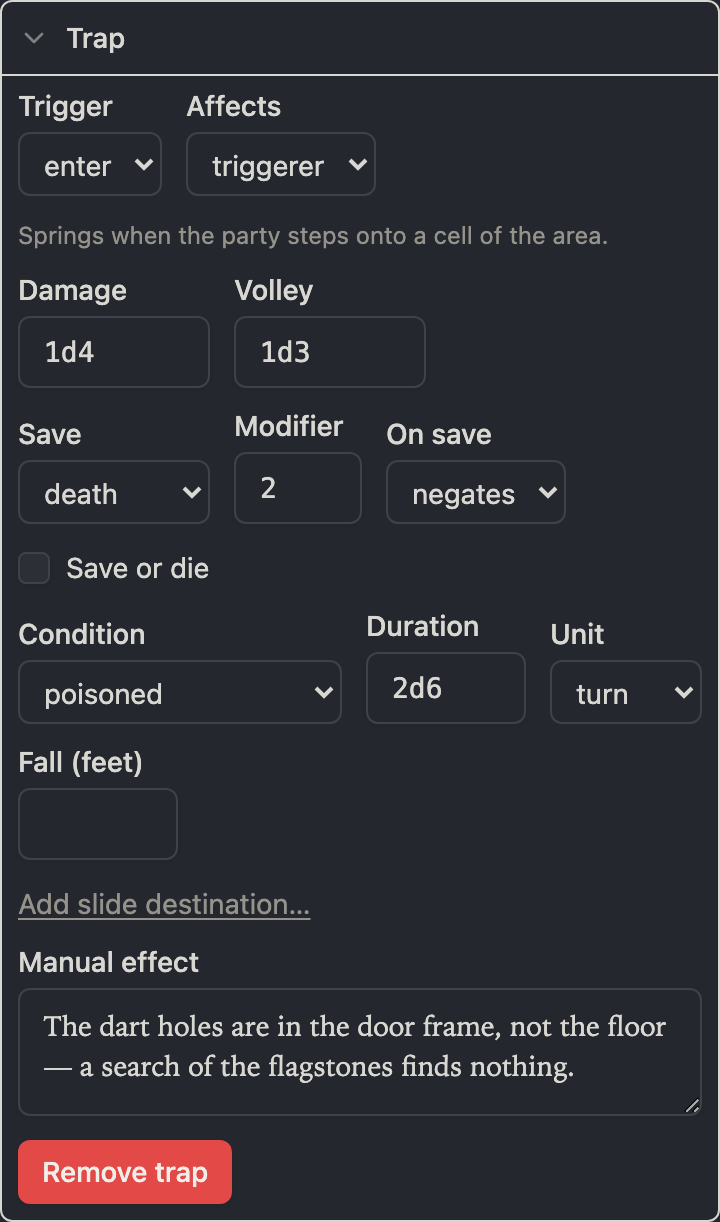
Damage, the save, and the condition are each set here, so the volley, the modifier and on-save pair, and the duration and unit are all live. Fall and the slide are the parts this trap doesn't have, and they stay empty.
Removing one
Remove trap on the card takes the room trap away; a cache's trap has its own Remove the trap inside the feature. Either is one undo step, like every other edit.